

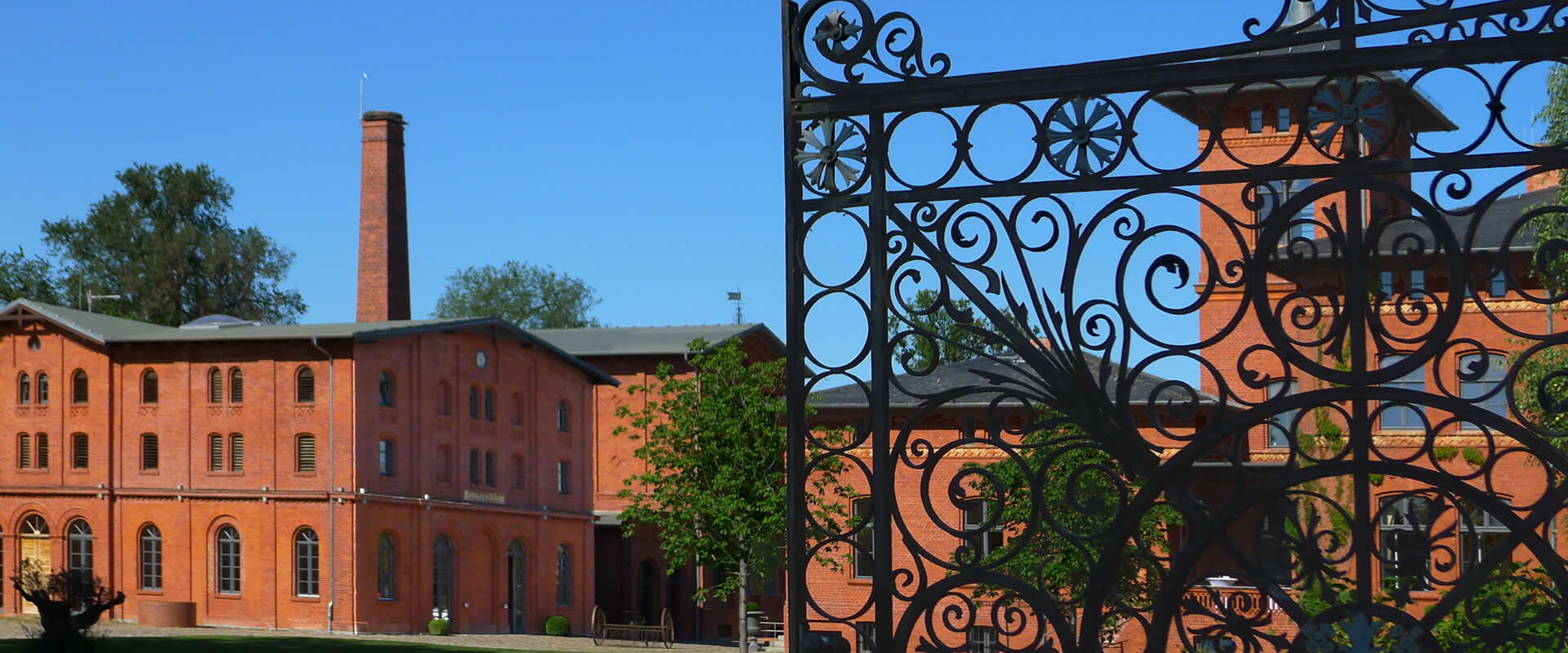
Conference Center Near Berlin – From Ruins to a Historic Venue
07/19/2018
“What is a steam engine? Well, let's pretend we know nothing and say that a steam engine is a big, round, black room. And that big, round, black room has two holes.”
Did Hans Pfeiffer, the one with three f's, understand the technical explanations given by secondary-school teacher Bömmel? Did Bömmel, a scatterbrained teacher in the film “Die Feuerzangenbowle”, understand them himself? One has to doubt it and, if he wasn't just a character in an old film, one might recommend a visit to Landgut Stober in Groß Behnitz, a district of Nauen.
There, in the former distillery, where industrial alcohol was once produced from grain or potatoes, there is a steam engine weighing several tonnes, manufactured by the Borsig company – who else, after all, given that the estate belonged to the industrialist family once famous for its steam locomotives.
Today there is a restaurant, a wine bar, a farm shop, conference rooms of all sizes, and even the opportunity to celebrate a stylish wedding and accommodate guests in the estate's two hotels, all of this surrounded by idyllic countryside, with views of the lake included.
But whether a large group is staying for a private celebration such as a wedding or for professional reasons, perhaps to attend a rather more prosaic conference, guests can take part in a lesson on steam-engine technology as part of the accompanying programme. Under expert guidance, they can dismantle and reassemble selected components and even earn a certificate. Bömmel and Pfeiffer could still learn something.
THE LEGAL DISPUTE OVER THE NAME BORSIG IS STILL ONGOING
This restoration of the once-ruined Borsig estate, which was expropriated after the end of the war and fell into complete disrepair during the GDR era, was made possible by property developer Michael Stober, whose name the estate also bears today. One of the heirs, the son of the last owner, raised legal objections to the use of the Borsig name, and the dispute remains unresolved.
Even without the famous name, which can still be seen throughout Berlin, business at the hotel complex, with its restaurants and event facilities, is clearly thriving – so much so that Michael Stober has already had to turn down numerous enquiries. The assembly-line principle may be a blessing for industrial businesses, but it is hardly suitable for weddings or conferences. However, plans to expand the hotel facilities are firmly in place, with the aim of overcoming these capacity constraints in the foreseeable future.
Such success was far from certain when Stober took over the estate in 2000. Some of his friends and acquaintances thought he was crazy. He had just returned from the Baltic coast, where he had considered buying two manor houses, only to discover that both were infested with dry rot. A friend then recommended the former Borsig estate, which was also due to be auctioned. Stober visited the property and saw the widespread decay: empty window openings, vegetation growing through dilapidated roofs and piles of rubbish inside the buildings. Yet, with his experience in restoring even severely deteriorated historic properties, he recognised that much of the building structure was still intact or at least repairable. He told himself: “Either you do it, or nobody will.” So Stober bought the estate.
Since then, substantial sums have been invested in the grounds, which originally covered 30,000 square metres and now still extend over 20,000 square metres. Michael Stober puts the investment at €18 million, with just under a third financed by grants, another third by bank loans and the remainder through his own capital following the sale of properties he owned.
However, the new estate owner, who now lives there with his family, did not embark on a massive building programme all at once. Instead, he allowed the property to develop gradually. First, the former Borsig guesthouse – a smaller replica of the manor house demolished in 1946/47, even before Berlin's City Palace – was converted into a hotel. Then Brandenburg's first certified organic hotel was built on the site of a long-demolished barn, complete with a photovoltaic system for electricity generation, rainwater used for flushing toilets, wood-fired heating and rooms designed to reduce electromagnetic exposure.
At the time, the estate offered 256 beds in 128 double rooms and suites – still too few for some conferences, as business guests generally travel alone. Another building with 172 single rooms was therefore planned for the site of the former piglet barn on the village street.
THE TASK: HARMONISING HISTORIC BUILDINGS WITH NEW USES
For Stober, to the delight of heritage conservationists, it goes without saying that this new building should also respect the site's history and retain the same overall dimensions as the original stable. He has already done this with the organic hotel. He describes his guiding principle as requiring great sensitivity to understand and complement existing structures. The conversion of the poultry house and calf barn into a restaurant with a terrace overlooking the romantically overgrown shores of Lake Groß Behnitz has blended seamlessly into the ensemble of brick buildings. The new functions of the old granary, distillery, cattle barn and estate manager's house are barely visible from the outside. Inside, they accommodate 25 function rooms suitable for conferences, events and private celebrations, as well as a farm shop, wedding room, historic printing workshop and much more. And inside, Stober has successfully tried to bring the historic building fabric and its new functions into harmony. The large number of rooms of very different, sometimes even flexible sizes even allows for completely new types of events, beyond traditional conference formats based on lectures and presentations.
75 PERCENT OF OVERNIGHT OVERNIGHTS ARE AT CONFERENCES
Currently, conference guests account for around 75 percent of overnight stays. If you include other corporate meetings, company celebrations and weddings, it's already 95 percent – an astonishing success, considering that Michael Stober himself says Groß Behnitz seemed to be at the end of the world when he first arrived. Since then, Berlin has effectively moved closer – although Deutsche Bahn has not yet responded to his request to reconnect Groß Behnitz to the railway network with its own station, as it was in the Borsig era, by extending the RB13 service beyond Wustermark, despite his willingness to finance the station.
So until further notice, guests have to travel by car, which takes around 50 minutes from the Brandenburg Gate. Alternatively, they can take the bus from Nauen railway station. Currently, 60 full-time employees, most of whom come from the town and the region, as well as 150 seasonal employees take care of the guests.
Michael Stober also takes an unconventional approach to staffing, just as he strives to run his business responsibly, with a focus on organic products, climate neutrality and the common good – efforts that have earned him several awards. Employing refugees? Of course, although language barriers might make reception work difficult. Jobs in the kitchen, housekeeping or technical services are certainly possible, provided the new colleague is also welcomed by the existing team. And so, when Stober hired a Syrian refugee to work in the kitchen two years earlier, he personally introduced him to the staff on his first day of work and shared the story of his flight from Syria. It worked.
Stober is just as happy to talk about the history of the Borsig family as he is about the success of his “vision” after his first encounter with the estate. Over the almost two decades since then, he has developed into an expert on this industrial dynasty. During excavation work, the remains of Germanic settlements were even discovered on the site.
The estate's history becomes clearer at the beginning of the 19th century, when Peter Alexander von Itzenplitz, grandson of one of Frederick II's famous generals, had a manor house built there. His heirs quickly allowed the estate to decline, and Albert Borsig purchased it in 1866.
Since August Borsig founded the company in 1837, the Berlin company Borsig had quickly developed into a leading heavy-industry enterprise. It was famous not only for its steam locomotives but also for shaping Berlin's cityscape with the steel structures of various domed buildings, of which only the dome of St Nicholas' Church in Potsdam has survived.
THE SCULPTURAL DECORATIONS COME FROM BERLIN'S ORANIENBURG GATE
However, the Borsigs, whose family business only went bankrupt during the Great Depression and was subsequently sold, by no means fit the stereotype of greedy exploiters; rather, they ran their company in a remarkably humane way for its time, including a company welfare fund, bathing facilities and a canteen. The estate, which was run using the most modern methods and the latest technology, also featured sandstone ornaments that Albert Borsig had salvaged from Berlin's Oranienburg Gate when it was demolished in 1867 and incorporated into the estate's entrance. The estate not only served as a place of relaxation for the family but also supplied fresh food to the company's canteen.
Later, when the company went bankrupt, the estate became the setting for another chapter of history during a dark period. Now managed by Ernst von Borsig, it was one of the meeting places of the Kreisau Circle resistance group.
With him, the great-grandson of the company founder, the Borsigs' time in Groß Behnitz ended. Although Ernst von Borsig escaped the attention of the Gestapo, he did not survive imprisonment in a Soviet camp after the war, and the estate was expropriated. After German reunification, Ernst von Borsig's son Manfred unsuccessfully sought the return of the property through legal action.